
Your Backyard Could Be the Next Data Center — And You Might Actually Get Paid for It

For the past few years, the conversation around AI data centers has been loud — and not always in a good way. Communities across the country have been pushing back against massive facilities that devour electricity, strain local grids, and drop billion-dollar footprints into neighborhoods that never asked for them. Over 25 data center projects were canceled in 2025 alone due to local opposition, and that number is already on pace to shatter records in 2026. In Illinois, Seattle, and Austin, residents and city officials are drawing hard lines.
So where does all that computing power go instead?
That's the question a startup called SPAN — backed by Nvidia and now partnering with one of the country's largest homebuilders, PulteGroup — is trying to answer. And their solution is genuinely surprising: your backyard.
What Is SPAN XFRA, and Why Is It a Big Deal?

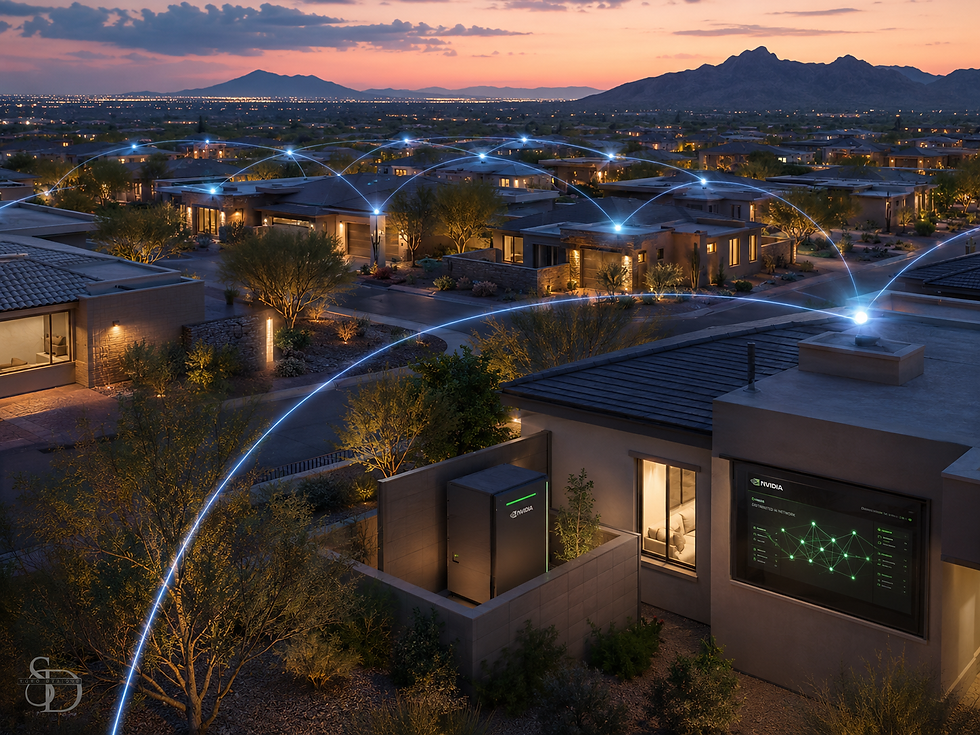
SPAN makes smart electrical panels — the kind that give homeowners real-time visibility into their energy use and let them automate when appliances run. In April 2026, the company announced XFRA, a distributed data center network built not in industrial parks, but in the side yards and utility spaces of residential homes.
Here's how it works: most homes have more electrical capacity running to them than they actually use at any given time. That idle capacity just sits there. SPAN's idea is to plug into that unused power and run a compact, liquid-cooled compute node — essentially a mini AI server — right next to your HVAC unit or water heater.
Each XFRA node packs some serious hardware: 16 Nvidia RTX Pro 6000 Blackwell GPUs, 4 AMD EPYC processors, and 3 TB of RAM housed in a Dell PowerEdge server. Multiply that across hundreds or thousands of homes, and you suddenly have a distributed supercomputing network that can handle real AI workloads — without ever building a single massive facility.
Where PulteGroup Comes In
PulteGroup, the third-largest homebuilder in the United States, is already testing XFRA nodes in newly constructed homes. The pilot program is targeting the Southwest — Nevada and Arizona are the leading candidates — with roughly 100 homes planned for the Q3 2026 proof of concept.
The fact that Arizona is in the mix is notable. We're already watching major infrastructure decisions play out right here in the Valley, and the idea that new construction communities could become distributed compute hubs adds a genuinely new dimension to how land, power, and housing intersect.
For PulteGroup, the economics are straightforward: if XFRA works, it becomes a differentiator in new home sales. Buyers get a smart panel, battery backup, potentially solar, and discounted electricity and internet — all at no upfront cost. The XFRA company offsets those homeowner costs through the revenue it earns renting the compute capacity to AI companies.
Why the Timing Makes Sense
The grid is under serious pressure right now. PJM Interconnection — the operator serving over 65 million people across 13 states — is projected to run 6 gigawatts short of its reliability requirements by 2027. Data centers are a primary driver of that shortfall. Communities aren't just annoyed about it; they're actively blocking new builds. More than $41.7 billion in proposed data center investment was shelved in just the first quarter of 2026 due to local opposition.
At the same time, the demand for AI compute isn't going anywhere. It's accelerating. The bottleneck isn't chips — Nvidia has plenty of those. The bottleneck is power and the ability to bring it online fast.
Distributed residential networks solve both problems. Instead of asking a city to absorb the load of one massive facility, you're spreading 1.25 megawatts of compute across 100 homes — each pulling a modest amount of power that was already available. No new substations. No years-long grid interconnection queues. No city council hearings.
It's the same logic that made rooftop solar work. Instead of one giant power plant, you get thousands of smaller contributors that collectively add up to something significant.
What This Could Mean for Homebuyers
If this scales the way SPAN is planning — they're targeting over 1 gigawatt of annual capacity by 2027 — homeowners who participate in XFRA would essentially be hosting a small piece of the internet's AI infrastructure in exchange for real financial benefits:
Dramatically reduced electricity costs through flat-rate pricing
Discounted internet service
Free smart panel installation (normally $3,000–$5,000)
Battery backup included, adding resilience during outages
It's not entirely unlike renting out a room on Airbnb, except the "guest" is a liquid-cooled GPU cluster that runs quietly in your side yard and never leaves a mess.
The Questions Still on the Table
This concept is new enough that plenty of unknowns remain. What happens if you want to sell the house — does the XFRA agreement transfer? What are the liability implications if the hardware malfunctions? Will HOAs in master-planned communities allow the installations? And how does this affect homeowners insurance?
These are the kinds of details that tend to surface once a pilot scales into a real product. SPAN and PulteGroup are clearly in "test the concept" mode right now, which is the right approach. The fact that they're starting in new construction — where the systems can be designed in from day one rather than retrofitted — is a smart call.
A New Layer to What "Home" Means
We've watched homes evolve into power generators with solar, energy storage hubs with batteries, and now — potentially — computing nodes in a distributed AI network. Each of those shifts changed something about how homes are designed, permitted, and valued.
Whether XFRA becomes standard in new construction or fades out as an experiment, it signals something important: the industry is actively searching for ways to meet AI's insatiable appetite for computing power without the political and infrastructure headaches of mega-campuses. Residential real estate just became part of that conversation in a way it never was before.
That's worth paying attention to — whether you're a homebuyer, a builder, or anyone else trying to figure out where things are headed.
At SOKO Designs, we stay on top of the trends shaping the future of construction and development in Arizona. If you're planning a new build or want to talk through how emerging technologies might affect your next project, we'd love the conversation. Reach us at 480-710-4866.
Comments